Hermitage Reveals $230 Million Stolen From Russian People
October 8, 2009
Today, October 8, 2009, investigators from the Russian Interior Ministry announced charges against Hermitage Capital Management’s legal adviser, Sergey Magnitskiy, and allegations against Hermitage’s CEO, William Browder.
These charges and allegations have been fabricated and brought directly in response to Hermitage and Magnitskiy implicating certain Interior Ministry officials in the theft of $230 million from the Russian budget.
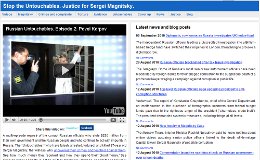
Due to the high level of corruption in the Russian Interior Ministry, along with the arbitrary powers they posses, many Russian newspapers have been afraid to write about the Interior Ministry’s role in this fraud. In an environment like this, where the freedom of the press is compromised, it is necessary to use new channels of communication to fight corruption in Russia. In order to avoid putting Russian journalists at risk, we are, therefore, releasing the following YouTube video to lay out story in full.
The Financial Times: Russian sharks are feeding on their own blood
July 6, 2009
By William Browder
When presidents Barack Obama and Dmitry Medvedev met on Monday for their first major summit, the main agenda items were arms control and Iran, and progress was made on the former, at least. This may encourage those who believe these issues can be dealt with in isolation from other challenges to US-Russia relations.
As someone who has been familiar with the country for the past 15 years, I believe that approach ignores fundamental differences between Russia today and most other nations. Simply put, Russia is not a “state” as we understand it. Government institutions have been taken over as conduits for private interests, some of them criminal. Property rights no longer exist, people who are supposed to enforce the law are breaking it, innocent people are victimised and courts have turned into political tools.
Rather than a normally functioning bureaucracy, Russia’s clans fight over control of government positions and the power to use state resources to expropriate assets. While corruption and legal abuse go on everywhere, the scale of them in Russia should affect the way all countries, particularly the US, deal with it.
My own case is illustrative of the breakdown of the state in Russia. From 1996 until 2005, I was the largest portfolio investor in the country, with $4bn (£2.5bn, €3bn) invested. In November 2005, the government suddenly took my visa away and declared me a “threat to national security”, I believe because I was outspoken about corruption at state-owned companies. This was followed by a cascade of malfeasance so extreme it would make a hardened criminal blush – which I believe was orchestrated by the authorities.
Testimony of William Browder. Commission on Security & Cooperation in Europe the U.S. Helsinki Commission.
June 23, 2009
”Mr. Chairman and Distinguished Members of the Commission, thank you for inviting me to appear before you today.
I have been asked to share my thoughts on the rule of law in Russia. Unfortunately, my own personal experience shaped by fifteen years of investing in that country confirms to me that the situation in Russia is not a pretty picture, and it is getting worse.
When I first started Hermitage in the mid-1990’s, my clients would ask me about the Russian horror stories they had heard of shareholders getting wiped off corporate registries, having assets stolen by crooked management or being the targets of corrupt government officials seeking bribes. What I was able to tell my investors back then is that while corporate governance was terrible, valuations were cheap, and investors would make money as Russia evolved from “horrible” to just “bad.” I am here today to tell you that Russia is reverting. The investor horror stories that were largely fantastic in the 1990’s are now commonplace. The situation in Russia is going from “bad” back to “horrible” and it will be more than just investors who lose out in this process.
The New York Times: An Investment Gets Trapped in Kremlin’s Vise
July 24, 2008
William F. Browder was one of the most prominent foreign investors here, a corporate provocateur who brought the tactics of Wall Street shareholder activists to the free-for-all of post-Soviet capitalism. Until, that is, the Kremlin expelled him in 2005.
Mr. Browder then focused on protecting his billions of dollars of stakes in major Kremlin-controlled companies, like Gazprom, and on fighting to return to a land where he had deep and unusual family ties. So when he ran into Dmitri A. Medvedev, the country’s future president, at the World Economic Forum in Davos last year, he saw his chance.
In a brief conversation at a dinner at the Swiss resort, he pressed Mr. Medvedev for help in regaining his Russian visa. Mr. Medvedev, then a top aide to President Vladimir V. Putin, agreed to pass along his request.
 For more information please visit